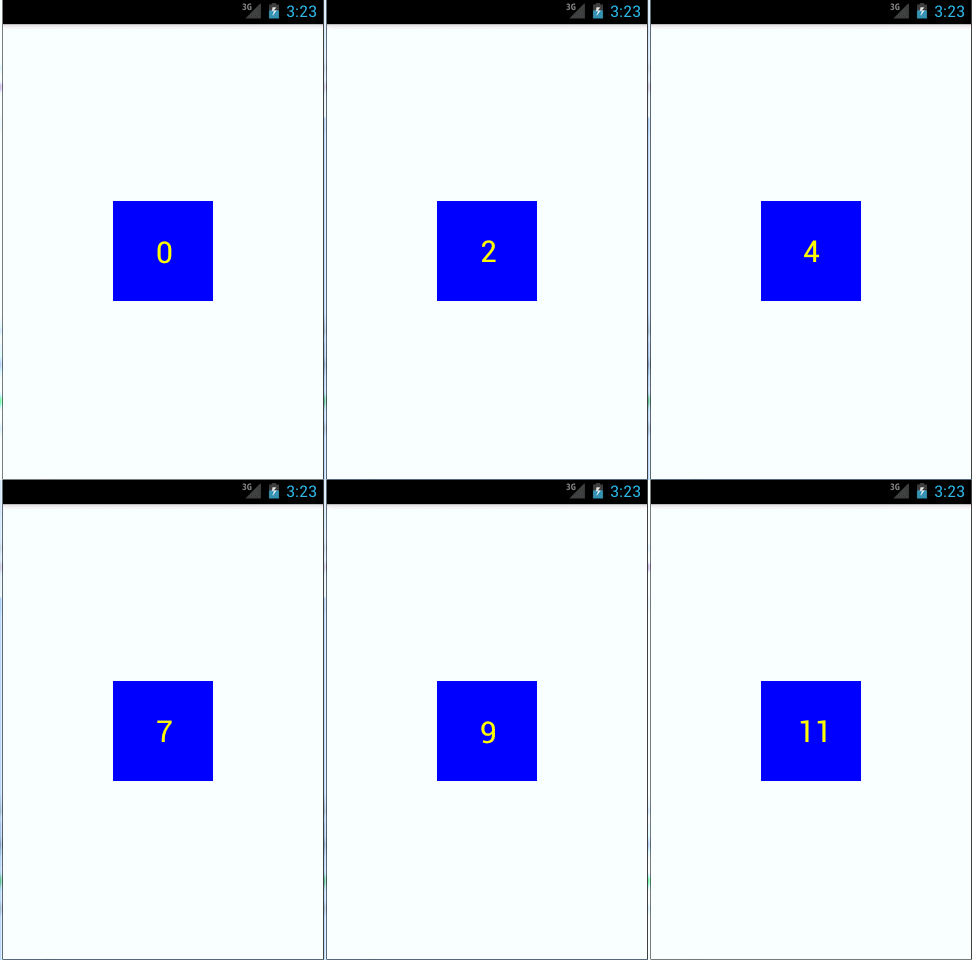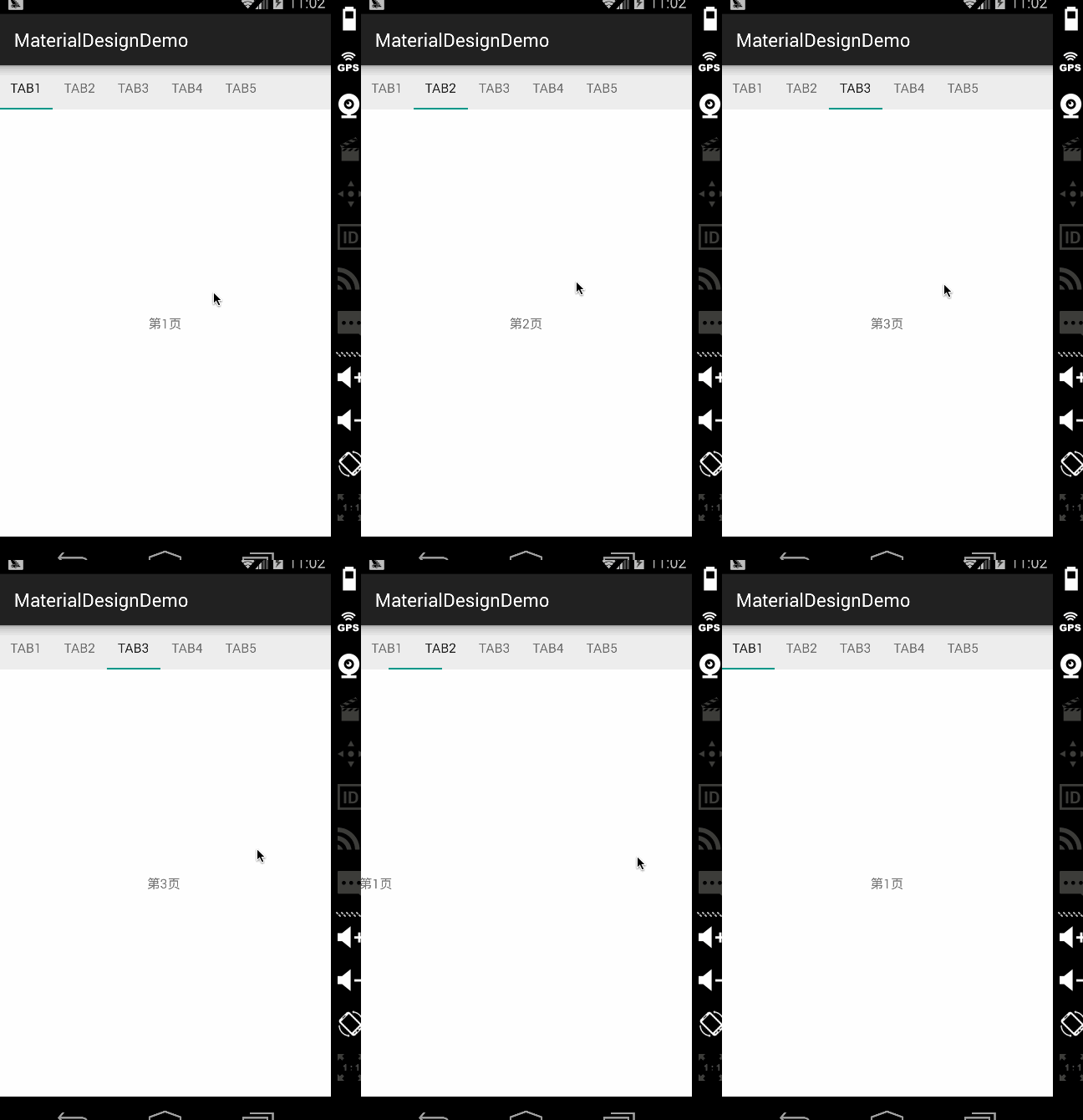
Interpolator 时间插值类,定义动画变换的速度。能够实现alpha/scale/translate/rotate动画的加速、减速和重复等。Interpolator类其实是一个空接口,继承自TimeInterpolator,TimeInterpolator时间插值器允许动画进行非线性运动变换,如加速和限速等,该接口中只有接口中有一个方法 float getInterpolation(float input)这个方法。传入的值是一个0.0~1.0的值,返回值可以小于0.0也可以大于1.0。


 /** * An interpolator where the rate of change is constant * */ @HasNativeInterpolator public class LinearInterpolator implements Interpolator, NativeInterpolatorFactory { public LinearInterpolator() { } public LinearInterpolator(Context context, AttributeSet attrs) { } public float getInterpolation(float input) { return input; } /** @hide */ @Override public long createNativeInterpolator() { return NativeInterpolatorFactoryHelper.createLinearInterpolator(); } }
 可以通过%20
/** * An interpolator where the rate of change starts out quickly and * and then decelerates. * */ @HasNativeInterpolator public class DecelerateInterpolator implements Interpolator, NativeInterpolatorFactory { public DecelerateInterpolator() { } /** * Constructor * * @param factor Degree to which the animation should be eased. Setting factor to 1.0f produces * an upside-down y=x^2 parabola. Increasing factor above 1.0f makes exaggerates the * ease-out effect (i.e., it starts even faster and ends evens slower) */ public DecelerateInterpolator(float factor) { mFactor = factor; } public DecelerateInterpolator(Context context, AttributeSet attrs) { this(context.getResources(), context.getTheme(), attrs); } /** @hide */ public DecelerateInterpolator(Resources res, Theme theme, AttributeSet attrs) { TypedArray a; if (theme != null) { a = theme.obtainStyledAttributes(attrs, R.styleable.DecelerateInterpolator, 0, 0); } else { a = res.obtainAttributes(attrs, R.styleable.DecelerateInterpolator); } mFactor = a.getFloat(R.styleable.DecelerateInterpolator_factor, 1.0f); a.recycle(); } public float getInterpolation(float input) { float result; if (mFactor == 1.0f) { result = (float)(1.0f - (1.0f - input) * (1.0f - input)); } else { result = (float)(1.0f - Math.pow((1.0f - input), 2 * mFactor)); } return result; } private float mFactor = 1.0f; /** @hide */ @Override public long createNativeInterpolator() { return NativeInterpolatorFactoryHelper.createDecelerateInterpolator(mFactor); } } float Elastic::easeIn (float t, float b , float c, float d) { <span style="white-space:pre"> </span>if (t==0) return b; if ((t/=d)==1) return b+c; <span style="white-space:pre"> </span>float p=d*.3f; <span style="white-space:pre"> </span>float a=c; <span style="white-space:pre"> </span>float s=p/4; <span style="white-space:pre"> </span>float postFix =a*pow(2,10*(t-=1)); // this is a fix, again, with post-increment public class Sine { public static float easeIn(float t,float b , float c, float d) { return -c * (float)Math.cos(t/d * (Math.PI/2)) + c + b; } public static float easeOut(float t,float b , float c, float d) { return c * (float)Math.sin(t/d * (Math.PI/2)) + b; } public static float easeInOut(float t,float b , float c, float d) { return -c/2 * ((float)Math.cos(Math.PI*t/d) - 1) + b; } } 虽然%20Java%20的也有了,但是话说这个怎么用啊,跟上面的Interpolator如何联系起来啊?/** * Created by Qiujuer on 2015/1/5. */ public class InSineInterpolator implements Interpolator{ public static float easeIn(float t,float b , float c, float d) { return -c * (float)Math.cos(t/d * (Math.PI/2)) + c + b; } @Override public float getInterpolation(float input) { return easeIn(input, 0, 1, 1); } } //AnimatorSet mAnimatorSet = new AnimatorSet(); mAnimatorSet.playTogether(aPaintX, aPaintY, aRadius, aBackground); mAnimatorSet.setInterpolator(new InSineInterpolator()); mAnimatorSet.start(); 可以看出使用与上面%20Android%20自带的完全一样,当然这个只是个%20Case%20,具体使用中你可以随意封装,前提是别改动了主要部分。[java] view%20plain copy print?/** * An interpolator where the rate of change starts out quickly and * and then decelerates. * */ @HasNativeInterpolator public class DecelerateInterpolator implements Interpolator, NativeInterpolatorFactory { public DecelerateInterpolator() { } /** * Constructor * * @param factor Degree to which the animation should be eased. Setting factor to 1.0f produces * an upside-down y=x^2 parabola. Increasing factor above 1.0f makes exaggerates the * ease-out effect (i.e., it starts even faster and ends evens slower) */ public DecelerateInterpolator(float factor) { mFactor = factor; } public DecelerateInterpolator(Context context, AttributeSet attrs) { this(context.getResources(), context.getTheme(), attrs); } /** @hide */ public DecelerateInterpolator(Resources res, Theme theme, AttributeSet attrs) { TypedArray a; if (theme != null) { a = theme.obtainStyledAttributes(attrs, R.styleable.DecelerateInterpolator, 0, 0); } else { a = res.obtainAttributes(attrs, R.styleable.DecelerateInterpolator); } mFactor = a.getFloat(R.styleable.DecelerateInterpolator_factor, 1.0f); a.recycle(); } public float getInterpolation(float input) { float result; if (mFactor == 1.0f) { result = (float)(1.0f - (1.0f - input) * (1.0f - input)); } else { result = (float)(1.0f - Math.pow((1.0f - input), 2 * mFactor)); } return result; } private float mFactor = 1.0f; /** @hide */ @Override public long createNativeInterpolator() { return NativeInterpolatorFactoryHelper.createDecelerateInterpolator(mFactor); } } 新闻热点






疑难解答