大家在日常中经常见到用xml文件实现android常用布局,但是大家知道如何用代码实现呢?使用代码实现可以帮助我们学习sdk api,所以小编把我日常整理些关于android常用布局代码实现分享给大家
关于 android 常用布局,利用 XML 文件实现已经有很多的实例了。但如何利用代码实现呢?当然利用代码实现没有太大的必要,也是不提倡的,但我觉得利用代码实现这些布局,可以更好的了解 SDK API ,所以在此也整理一些,和大家分享一下。
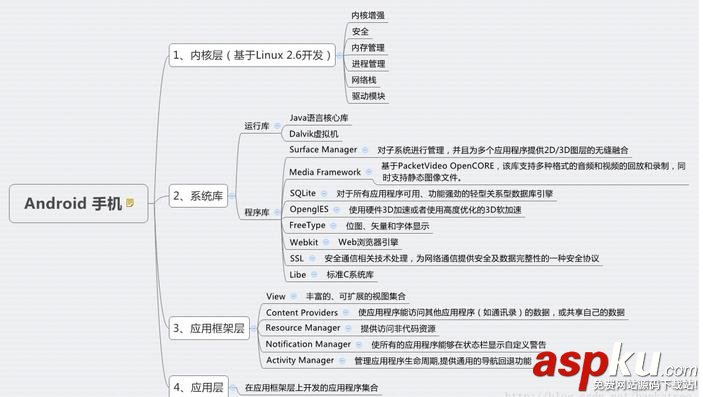
首先看一下,布局所对应的类的 API 继承图:

android常用布局的代码实现所有的布局都会对应相关的类,这些类都是继承自 android.view.ViewGroup 类的。而 LinearLayout,RelativeLayout 都是在 android.widget 包里的。另外,TableLayout 是继承自 LinearLayout.
下面直接贴代码了。
- // 利用代码设置 线性布局
- private void setLinearLayout(){
- LinearLayout llayout = new LinearLayout(this);
- llayout.setOrientation(LinearLayout.VERTICAL); // 设置线性布局的排列方式
- TextView textView = new TextView(this);
- textView.setText("代码实现的线性布局");
- textView.setTextColor(Color.RED);
- textView.setGravity(Gravity.CENTER); // 设置文本内容的对齐方式
- LinearLayout.LayoutParams ll_lpara = new LinearLayout.LayoutParams(MP,WC);
- // ll_lpara.gravity = Gravity.CENTER_HORIZONTAL; // 设置控件在布局中的对齐方式
- llayout.addView(textView,ll_lpara);
- Button btn = new Button(this);
- btn.setText("按钮");
- llayout.addView(btn,ll_lpara); // 按指定属性添加控件
- setContentView(llayout);
- }
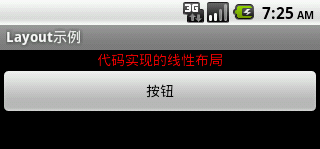
实现效果图:
=========================================================================
- // 利用代码设置 相对布局
- private void setRelativeLayout(){
- RelativeLayout rlayout = new RelativeLayout(this);
- rlayout.setPadding(10, 10, 10, 10); // 单位: pixels
- int textViewID = 100;
- TextView textView = new TextView(this);
- textView.setId(textViewID);
- textView.setText("请输入:");
- RelativeLayout.LayoutParams rl_lpara1 = new RelativeLayout.LayoutParams(MP, WC);
- rlayout.addView(textView, rl_lpara1);
- int editTextID = 200;
- EditText editText = new EditText(this);
- editText.setId(editTextID);
- editText.setBackgroundResource(android.R.drawable.editbox_background); // 设置背景 , 同android:backgroumd
- RelativeLayout.LayoutParams rl_lpara2 = new RelativeLayout.LayoutParams(MP, WC);
- rl_lpara2.addRule(RelativeLayout.BELOW,textViewID); // 设置相对属性,需先指定相对控件的ID
- rlayout.addView(editText, rl_lpara2);
- int backBtnID = 300;
- Button backBtn = new Button(this);
- backBtn.setId(backBtnID);
- backBtn.setText("返回");
- RelativeLayout.LayoutParams rl_lpara3 = new RelativeLayout.LayoutParams(WC, WC);
- rl_lpara3.addRule(RelativeLayout.BELOW, editTextID);
- rl_lpara3.addRule(RelativeLayout.ALIGN_PARENT_RIGHT); // 设置与父控件的相对属性
- rlayout.addView(backBtn, rl_lpara3);
- Button okBtn = new Button(this);
- okBtn.setText("确定");
- RelativeLayout.LayoutParams rl_lpara4 = new RelativeLayout.LayoutParams(WC, WC);
- rl_lpara4.addRule(RelativeLayout.LEFT_OF, backBtnID);
- rl_lpara4.addRule(RelativeLayout.ALIGN_TOP,backBtnID);
- rlayout.addView(okBtn, rl_lpara4);
- setContentView(rlayout);
- }
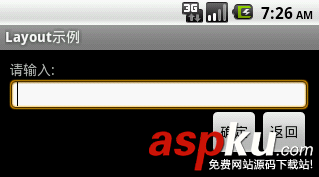
实现效果图:
=========================================================================
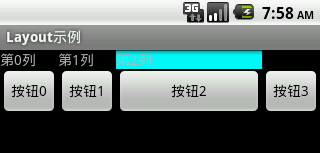
- // 利用代码设置 表格布局
- private void setTableLayout(){
- TableLayout tlayout = new TableLayout(this);
- tlayout.setColumnStretchable(2, true); // 拉长索引从0开始的第2列
- TableLayout.LayoutParams tl_lpara = new TableLayout.LayoutParams(MP,WC);
- // 1. TableRow 不需要设置 layout_width, layout_height
- // 2. TableRow 中的控件不能设置 layout_span 属性
- TableRow tr1 = new TableRow(this);
- TextView textView0 = new TextView(this);
- textView0.setText("第0列");
- tr1.addView(textView0);
- TextView textView1 = new TextView(this);
- textView1.setText("第1列");
- tr1.addView(textView1);
- TextView textView2 = new TextView(this);
- textView2.setText("第2列");
- textView2.setBackgroundColor(Color.CYAN);
- tr1.addView(textView2);
- tlayout.addView(tr1, tl_lpara);
- TableRow tr2 = new TableRow(this);
- Button btn0 = new Button(this);
- btn0.setText("按钮0");
- tr2.addView(btn0);
- Button btn1 = new Button(this);
- btn1.setText("按钮1");
- tr2.addView(btn1);
- Button btn2 = new Button(this);
- btn2.setText("按钮2");
- tr2.addView(btn2);
- Button btn3 = new Button(this);
- btn3.setText("按钮3");
- tr2.addView(btn3);
- tlayout.addView(tr2, tl_lpara);
- setContentView(tlayout);
- }
实现效果图:
新闻热点






疑难解答